Building Climate Resilience in the Manaslu Region: Reforestation, Women’s Leadership, and Sustainable Livelihoods
Published on Jan. 13, 2026, 10:23 a.m.
Reforestation, Women’s Empowerment, and Climate Resilience in Samagaun, Nepal
Community-Led Environmental Protection in the Manaslu (Nubri) Region
Introduction: Protecting the Himalayas Through Community Action
The Himalayan region of Nepal is one of the most ecologically sensitive areas in the world. High-altitude villages such as Samagaun and Samdo, located in the Nubri Valley of the Manaslu region, are facing increasing pressure from climate change, deforestation, population shifts, and economic hardship. These pressures threaten not only fragile mountain ecosystems but also the traditional livelihoods, food security, and cultural heritage of local communities.
In recent years, however, Samagaun has become a powerful example of how community-led reforestation, women’s empowerment, and sustainable development initiatives can work together to protect the environment while improving quality of life. Through the combined efforts of local people, women’s groups, and supporting organizations such as Peak Aid Japan, Mountaineering Rescue Training Nepal Foundation (MRTFN), and the Himalayan Environment and Life Protection (HELP) initiative, the village is taking meaningful steps toward ecological restoration and long-term resilience.
This blog explores three major pillars of this transformation:
The Samagaun Reforestation Project
The role of Ama Samuha (Mother’s Groups) in women’s empowerment and community governance
Climate adaptation and livelihood support through the HELP initiative
Together, these initiatives show how local knowledge, community ownership, and environmental responsibility can protect the Himalayas for future generations.
Samagaun: A Remote Himalayan Village at a Crossroads
Samagaun is a traditional Tibetan-influenced village located at approximately 3,500 meters above sea level, near the base of Mount Manaslu (8,163 m). The village is accessible only after a 4–5 day walk, as there is no road access, making transportation of goods, food, and materials extremely difficult.
For generations, the people of Samagaun depended on:
Subsistence agriculture (potatoes, barley, buckwheat)
Livestock farming (yaks, sheep)
Forest resources for fuel, construction, and income
However, changes in climate patterns, population needs, and economic opportunities have placed growing stress on forests and farmland. In the past, many villagers cut trees and sold timber to neighboring Tibet as a means of survival. While this provided short-term income, it led to serious deforestation, soil erosion, and environmental degradation.
Today, the community recognizes that protecting forests is essential for survival, not only for biodiversity but also for water sources, disaster prevention, agriculture, and cultural continuity.
The Samagaun Reforestation Project: Restoring Forests, Restoring Balance
Project Background and Objectives
The Samagaun Reforestation Project was established in 2016 with the support of Peak Aid Japan and is coordinated locally by the Mountaineering Rescue Training Nepal Foundation (MRTFN). The project was created in response to the urgent need to restore forest cover in and around Samagaun and to reduce dependence on remaining natural forests.
The primary objectives of the project are:
To restore degraded forest areas
To promote native tree species suitable for high-altitude environments
To involve the local community directly in conservation efforts
To ensure long-term environmental sustainability
Plantation Activities and Achievements
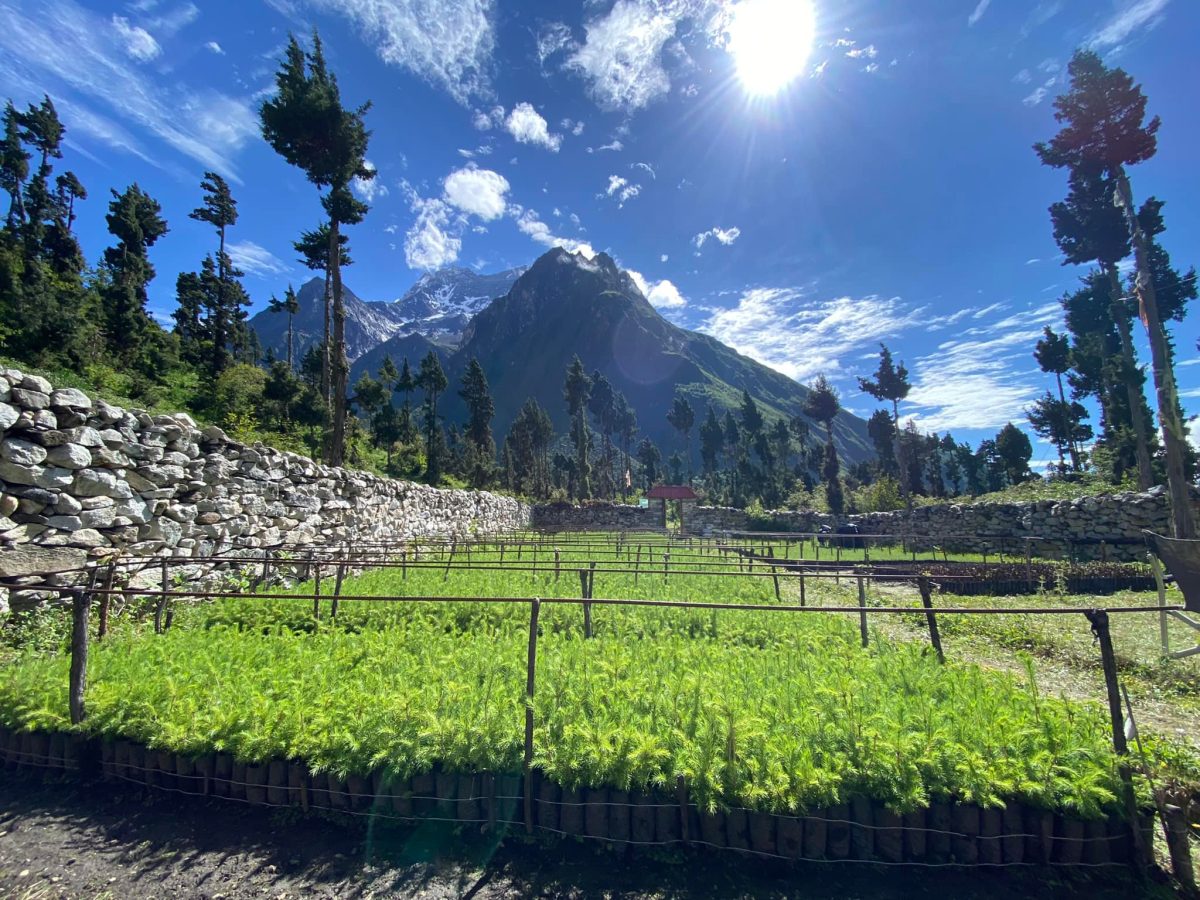
Since its inception, the project has focused mainly on planting Sallo trees (Himalayan pine), which are well adapted to the climate, soil, and altitude of the region.
Key achievements include:
More than 50,000 trees planted to date
Plantation sites include:
Tau area
Pegyap area
Gumba area
Several private lands
The first plantation trial, conducted in 2018 in the Tau area, was highly successful. The saplings showed strong, healthy growth, proving that carefully planned reforestation is possible even in harsh mountain conditions.
Every planting season, approximately 12,000 to 15,000 saplings are grown in the nursery and planted in suitable locations. Monitoring has shown a very encouraging survival rate of 80–85% in open plantation areas.
Community Involvement and Sapling Distribution
Community participation is a cornerstone of the project. To strengthen local ownership, the project distributed 16,000 saplings directly to villagers in Samagaun.
Each household received 100–150 saplings
Families planted trees on their private land
This approach expanded forest cover beyond public areas
It created a sense of responsibility and pride among villagers
By involving families directly, reforestation is no longer seen as an external project, but as a shared community mission.
Local Management and Nursery Operations
The project is managed by dedicated local staff members:
Ang Temba
Bir Bahadur
Tsewang Gyurme
Tenzin Norbu
Their responsibilities include:
Nursery management
Sapling production
Plantation and monitoring
Coordination with partner organizations
With continuous support from Peak Aid Foundation and MRTFN, the nursery is well maintained and now produces not only Sallo trees but also other plant species that are in high demand in the region.
Looking Ahead: Expanding Reforestation Beyond Samagaun
The long-term vision of the project includes:
Increasing sapling production
Extending reforestation to neighboring villages
Strengthening environmental education
Supporting regional forest protection in the Manaslu Conservation Area
Ama Samuha (Mother’s Group): The Backbone of Community Governance
Women’s Role in Nepali Society
In Nepal, there is a well-known saying:
“Men and women are like two wheels of a cart.”
Yet in reality, women’s contributions are often undervalued, especially in rural and mountain communities. Women perform most of the agricultural work, household labor, childcare, and resource collection, but their work often goes unrecognized.
Many women face:
Limited access to education
Low self-confidence due to social norms
Few opportunities for leadership
Heavy workloads without decision-making power
Empowering women is not only a matter of equality—it is essential for sustainable development, community resilience, and environmental protection.
Ama Samuha: A Tradition of Women’s Leadership
Ama Samuha (Mother’s Group) is a traditional volunteer women’s organization that began in rural Nepal during the 1980s. These groups first emerged in Gurung and Magar communities, where many men were serving abroad in the army in Nepal, India, and the United Kingdom.
Initially, Ama Samuha focused on:
Cultural and religious events
Social support within the village
Community harmony
Over time, with support from NGOs and development partners, these groups expanded their role to include:
Women’s rights and empowerment
Community development
Health, hygiene, and education
Local governance and rule-making
Ama Samuha in Samagaun: Women Leading Change
In Samagaun, the Ama Samuha operates independently and is one of the few platforms where women can make decisions on their own with full trust from the village.
Their work focuses on:
Women’s opportunities and responsibilities
Authority and leadership
Equality and respect in society
Community Rules and Social Management
The Mother’s Group plays a crucial role in maintaining social discipline and harmony in the village. Some of their important decisions include:
Allowing gambling games such as cards, Sho Para, and Bag only on Saturdays
Limiting alcohol consumption
Requiring hotels and small shops to close before 10 PM
Promoting a peaceful and respectful village environment
Community Activities and Cleanliness Programs
Ama Samuha members:
Organize cultural and community events
Prepare food and materials for programs
Manage logistics during village gatherings
Conduct monthly cleanliness campaigns to clean the entire village
Through these activities, women have become visible leaders, strengthening both social cohesion and environmental awareness.
Climate Change in the Nubri Region: Growing Challenges
The Nubri region is experiencing rapid climate change, with visible impacts on daily life. These include:
Increased demand for firewood due to colder temperatures
Higher risk of landslides and soil erosion
Declining agricultural productivity
Reduced availability of traditional crops like potatoes and barley
Women, who are traditionally responsible for collecting firewood and managing households, are particularly affected. At the same time, many men have left the villages to work illegally in Western countries as low-paid laborers, increasing the burden on women and elderly residents
HELP: Himalayan Environment and Life Protection Initiative
To address these challenges, the Himalayan Environment and Life Protection (HELP) association—founded by Mingyur Rinpoche—launched a comprehensive program to support the communities of Samagaun and Samdo.
The goal of HELP is to:
Protect fragile ecosystems
Support climate adaptation
Improve food security
Create sustainable livelihoods
Empower women
Community Reforestation and Forest Management in Samdo
Unlike many parts of Nepal, community forest management systems are still developing in the Nubri region. HELP supported the creation of a community reforestation group in Samdo, responsible for managing the village nursery.
Between 2023 and 2024:
20,000 local trees were planted
Local people managed nursery operations
Community ownership was strengthened
Agroforestry and Biodiversity Protection
HELP also promotes agroforestry, planting trees near farmland to:
Improve soil fertility
Increase biodiversity
Protect crops from wind and erosion
Naturally growing thorn bushes are used as natural barriers to protect fields from yaks, which roam freely before and after the summer grazing season.
Reducing Firewood Consumption in Hotels and Guesthouses
Hotels and guesthouses are the largest consumers of firewood in Samagaun and Samdo. To reduce pressure on forests, HELP encourages the use of oil-filled radiators, which:
Consume less electricity
Provide steady heat
Reduce or eliminate wood burning
Hotels are testing these heaters during the October 2024 trekking season to evaluate their effectiveness.
Sustainable Agriculture and Potato Protection
Potatoes are a staple food in the region, but climate change has caused:
Smaller potato sizes
Increased disease
Declining yields
If not addressed, potato farming may fail within 3–5 years. HELP has launched a long-term project to:
Introduce new potato seeds over two years
Test lab-developed resistant varieties
Integrate new crops with traditional farming systems
Evaluate results with local communities after three years
Creating Sustainable Livelihoods and New Markets
To reduce dependence on forest resources, HELP is developing micro-channels for local products, including:
Medicinal herbs
Essential oils
Wild garlic
Yak cheese
Yak wool
These initiatives aim to:
Protect biodiversity
Create income opportunities
Empower women
Preserve Himalayan culture and traditional livelihoods
Women’s Community House: A Space for Independence
As part of its vision for long-term empowerment, HELP is supporting the construction of a women’s community house in Samagaun. This space will allow women to:
Organize activities
Develop skills
Manage income-generating projects
Strengthen leadership and cooperation
Conclusion: A Sustainable Future for Samagaun and the Himalayas
The combined efforts of reforestation, women’s leadership, climate adaptation, and sustainable livelihoods are transforming Samagaun and Samdo into models of community-driven environmental protection.
By restoring forests, empowering women through Ama Samuha, and addressing climate challenges through HELP initiatives, these Himalayan villages are building a future that respects nature, culture, and human dignity.
Their story proves that even in the most remote corners of the Himalayas, local action can create global impact.
Related Posts
Mountains and Peaks Along the Manaslu Circuit Trek
Published on Jan. 17, 2026, 10:12 a.m.
In the high Himalayas of Nepal’s Manaslu region, the village of Samagaun is restoring forests and …
Read more16-Day Manaslu Circuit Winter Trek: Snowy Trails, Larkya La Pass & Remote Villages
Published on Jan. 17, 2026, 7:09 a.m.
In the high Himalayas of Nepal’s Manaslu region, the village of Samagaun is restoring forests and …
Read moreBuilding Climate Resilience in the Manaslu Region: Reforestation, Women’s Leadership, and Sustainable Livelihoods
Published on Jan. 13, 2026, 10:23 a.m.
In the high Himalayas of Nepal’s Manaslu region, the village of Samagaun is restoring forests and …
Read moreManaslu Conservation Area: Everything You Need to Know Before Trekking
Published on Dec. 15, 2025, 12:09 p.m.
In the high Himalayas of Nepal’s Manaslu region, the village of Samagaun is restoring forests and …
Read moreExploring Nubri Valley Festivals: Culture, Rituals, and Himalayan Life
Published on Dec. 14, 2025, 4:29 a.m.
In the high Himalayas of Nepal’s Manaslu region, the village of Samagaun is restoring forests and …
Read more5-Day Annapurna Poon Hill Trek: Sunrise Views, Rhododendron Forests & Ghandruk Village Experience
Published on Dec. 11, 2025, 6:44 a.m.
In the high Himalayas of Nepal’s Manaslu region, the village of Samagaun is restoring forests and …
Read moreYarsagumba: The Himalayan Gold – Harvesting, Value, and Traditions Explained
Published on Dec. 10, 2025, 9:32 a.m.
In the high Himalayas of Nepal’s Manaslu region, the village of Samagaun is restoring forests and …
Read moreTraditional Himalayan Food Culture of Tsum and Nubri: A Deep Dive into Mountain Cuisine
Published on Nov. 23, 2025, 12:21 p.m.
In the high Himalayas of Nepal’s Manaslu region, the village of Samagaun is restoring forests and …
Read moreSama Mani Cultural Festival: Ancient Tibetan Opera, Dance & Ghee Offering Tradition in Samagaun
Published on Nov. 21, 2025, 8:28 a.m.
In the high Himalayas of Nepal’s Manaslu region, the village of Samagaun is restoring forests and …
Read moreManaslu Trek Permits Guide 2025: Costs, Rules, Required Documents & Entry Regul
Published on Nov. 20, 2025, 12:04 p.m.
In the high Himalayas of Nepal’s Manaslu region, the village of Samagaun is restoring forests and …
Read moreGyala Banjyang and Ruila Pass: Remote Nepal–Tibet Border Trails in the Manaslu Region
Published on Nov. 19, 2025, 3:40 a.m.
In the high Himalayas of Nepal’s Manaslu region, the village of Samagaun is restoring forests and …
Read morePungyen Gumba – The Best Acclimatization Hike From Samagaun (Manaslu Trek)
Published on Nov. 17, 2025, 4:34 a.m.
In the high Himalayas of Nepal’s Manaslu region, the village of Samagaun is restoring forests and …
Read moreUltimate Guide to Drinks in Tsum Valley: Culture, Tradition, and Trekker’s Experience
Published on Oct. 26, 2025, 9:48 a.m.
In the high Himalayas of Nepal’s Manaslu region, the village of Samagaun is restoring forests and …
Read moreThree Major Monasteries of Lo-Manthang: Spiritual and Cultural Marvels of Upper Mustang
Published on Oct. 26, 2025, 9:34 a.m.
In the high Himalayas of Nepal’s Manaslu region, the village of Samagaun is restoring forests and …
Read moreFestivals of Upper Mustang: A Celebration of Culture, Spirit, and Community
Published on Oct. 26, 2025, 9:15 a.m.
In the high Himalayas of Nepal’s Manaslu region, the village of Samagaun is restoring forests and …
Read moreWhy Trek in Nepal
Published on Oct. 26, 2025, 8:43 a.m.
In the high Himalayas of Nepal’s Manaslu region, the village of Samagaun is restoring forests and …
Read moreIndigenous Knowledge & Traditional Ecological Practices
Published on Aug. 21, 2025, 11:27 a.m.
In the high Himalayas of Nepal’s Manaslu region, the village of Samagaun is restoring forests and …
Read moreClimate Change in the Himalayas
Published on Aug. 21, 2025, 11:15 a.m.
In the high Himalayas of Nepal’s Manaslu region, the village of Samagaun is restoring forests and …
Read moreEco-Trekking in Nepal: Sustainable Adventures Through Protected Areas
Published on Aug. 21, 2025, 11:10 a.m.
In the high Himalayas of Nepal’s Manaslu region, the village of Samagaun is restoring forests and …
Read moreEthical Tourism and Porter Welfare
Published on Aug. 21, 2025, 10:59 a.m.
In the high Himalayas of Nepal’s Manaslu region, the village of Samagaun is restoring forests and …
Read moreGhorepani-Poon Hill: Lesser-Known Short Treks in Nepal
Published on Aug. 15, 2025, 10:40 a.m.
In the high Himalayas of Nepal’s Manaslu region, the village of Samagaun is restoring forests and …
Read moreTrekking to Ancient Monasteries in Mustang and Dolpo: A Journey into Nepal’s Hidden Cultural Heart
Published on Aug. 15, 2025, 10:35 a.m.
In the high Himalayas of Nepal’s Manaslu region, the village of Samagaun is restoring forests and …
Read moreCaves of Nepal: Exploring the Hidden Underground Wonders
Published on Aug. 15, 2025, 10:31 a.m.
In the high Himalayas of Nepal’s Manaslu region, the village of Samagaun is restoring forests and …
Read moreWaterfalls of Nepal: Hidden Cascades and Natural Wonders Off the Beaten Path
Published on Aug. 15, 2025, 10:27 a.m.
In the high Himalayas of Nepal’s Manaslu region, the village of Samagaun is restoring forests and …
Read moreHidden Treks of Nepal: Exploring Lesser-Known Trails
Published on Aug. 15, 2025, 10:22 a.m.
In the high Himalayas of Nepal’s Manaslu region, the village of Samagaun is restoring forests and …
Read moreTop 10 Hidden Hikes in Tsum Valley, Nepal
Published on June 5, 2025, 9:21 a.m.
In the high Himalayas of Nepal’s Manaslu region, the village of Samagaun is restoring forests and …
Read moreHow to Prevent and Handle Altitude Sickness – A Comprehensive Guide for Trekkers in the Himalaya
Published on June 4, 2025, 9:28 a.m.
In the high Himalayas of Nepal’s Manaslu region, the village of Samagaun is restoring forests and …
Read moreTrekking Solo vs. With a Guide: A Comprehensive Breakdown of Pros and Cons
Published on June 4, 2025, 9:25 a.m.
In the high Himalayas of Nepal’s Manaslu region, the village of Samagaun is restoring forests and …
Read moreAvoiding Common Hiking Mistakes: A Comprehensive Guide for Safer and More Rewarding High-Altitude Adventures
Published on May 25, 2025, 7:37 a.m.
In the high Himalayas of Nepal’s Manaslu region, the village of Samagaun is restoring forests and …
Read moreBeginner’s Guide to Trekking in Nepal – Everything You Need to Know Before Your First Adventure
Published on May 22, 2025, 9:36 a.m.
In the high Himalayas of Nepal’s Manaslu region, the village of Samagaun is restoring forests and …
Read moreHow to Train for a MultiDay Trek: A Comprehensive Guide to Prepare Your Body and Mind
Published on May 22, 2025, 9:21 a.m.
In the high Himalayas of Nepal’s Manaslu region, the village of Samagaun is restoring forests and …
Read moreTsum Valley: History of Shyagya Tradition Unique Features of Tsum Valley History of the Shyagya Tradition The Seven Shyagya Rules Tsum Shyagya Tradition Conservation Committee The Centennial Shyagya Festival Current Root Guru Drukpa Rinpoche
Published on March 26, 2025, 10:47 a.m.
In the high Himalayas of Nepal’s Manaslu region, the village of Samagaun is restoring forests and …
Read more